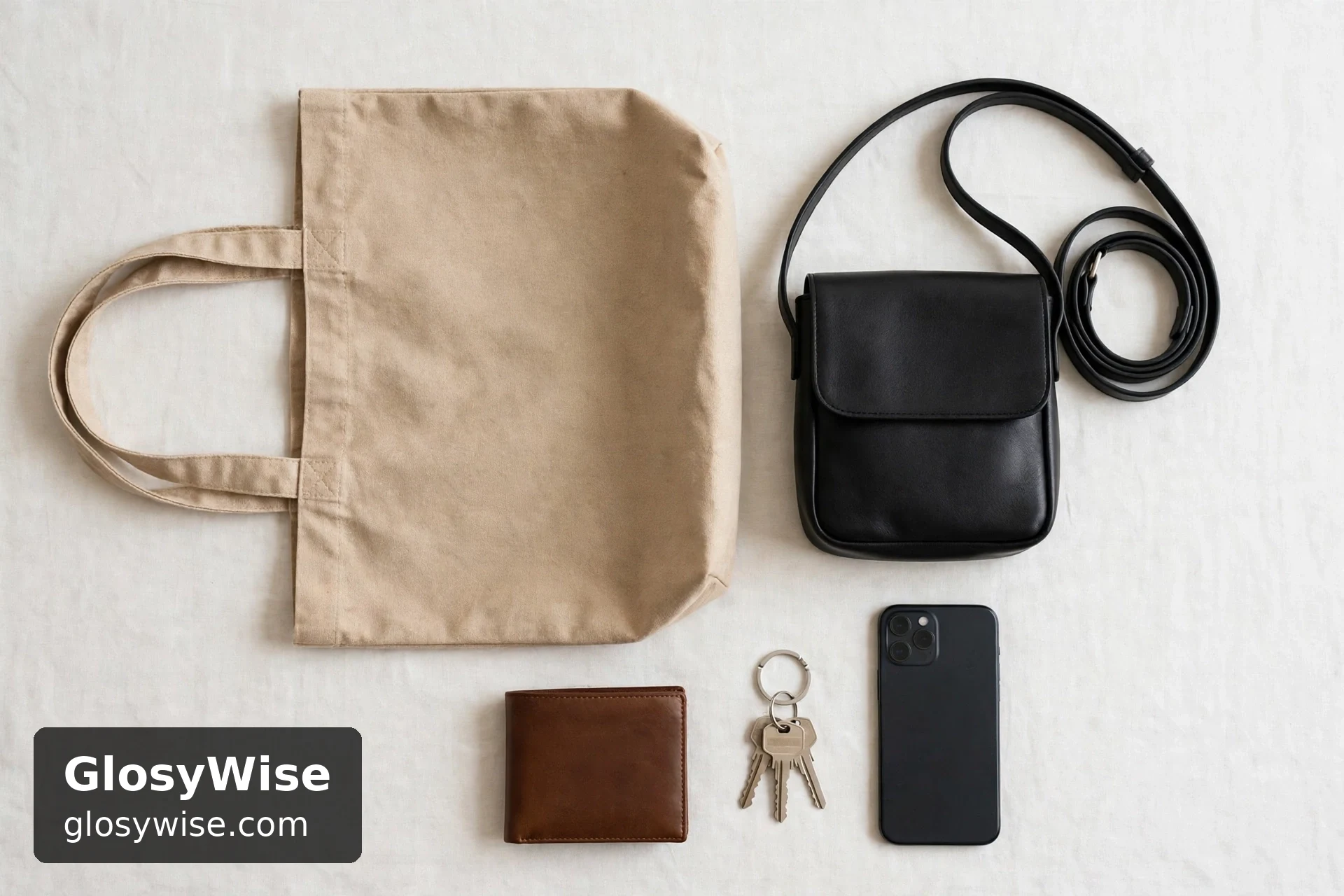
Your first handbag should fit your real life, not your wish list. Before you buy anything, empty your current bag and look at what you actually carry every day. That pile — wallet, phone, keys, and whatever else goes with you everywhere — decides the size you need. Then pick a neutral colour first, because black, tan or navy goes with everything you already own. Buy one bag that fits your daily life, and buy it well.
Step 1 — Empty Your Current Bag
Empty the bag you use now onto a table and sort it into two piles: things you use every day, and things you forgot were in there.
The everyday pile is your size requirement. Most people carry a wallet, phone, keys, a lip balm and tissues. If your pile is that small, a medium crossbody or a small tote will hold it all with room to spare.
The other pile does not count. Old receipts, loose change, broken pens — none of that is a reason to buy a bigger bag. A bag that is too big invites clutter, and clutter makes a bag heavy and hard to find anything in.
The Types, Explained in One Line Each
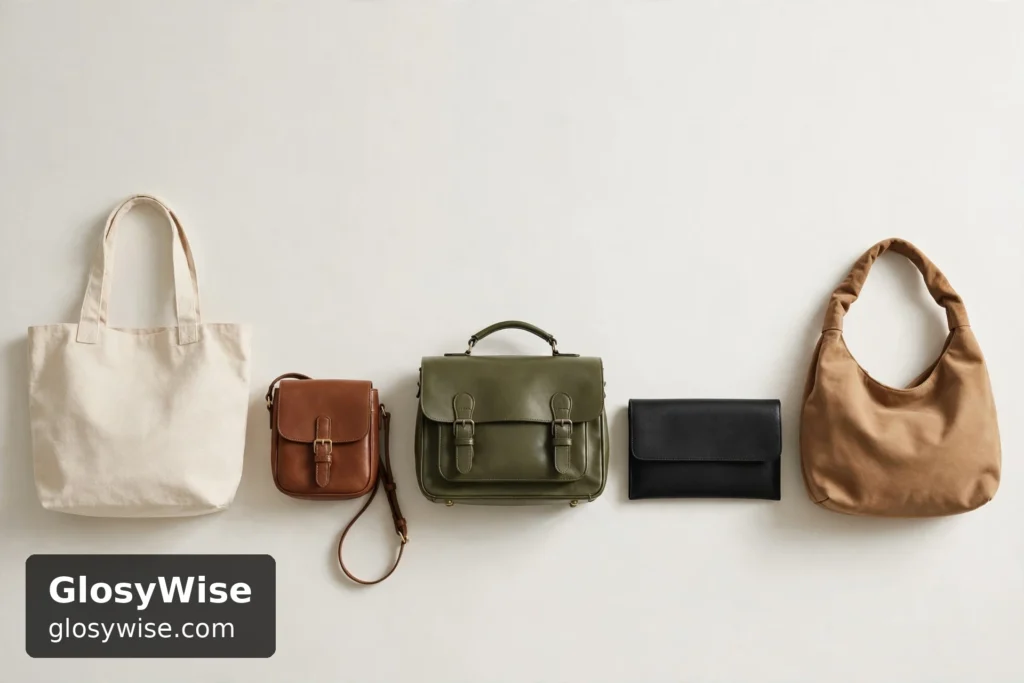
For a first bag you only need to know five types.
Tote. Carries a lot, with an open top and wide straps. It holds a laptop, a book and a water bottle.
Crossbody. Hands-free, with a long strap worn across the body. It keeps your hands free and stays close to you.
Satchel. Structured, with a short handle and a flap or top closure. It looks tidy and a little formal.
Clutch. Small, carried in the hand, for evenings only. It holds a phone, keys and a card holder — and almost nothing else. It is not a first bag.
Hobo. Soft, slouchy, with a curved top and a single shoulder strap. It feels relaxed and fits a casual wardrobe well.
Most beginners do best with a crossbody or a tote.
Size: How Big Is Too Big?
The right size is simple to judge: it should fit your daily carry plus a little room, not your whole life.
When you try a bag in a shop, put your things in it. Your wallet, phone and keys should go in easily, with space left over for the extras you sometimes carry — a water bottle, a small book, a scarf. If you have to force the zip closed, the bag is too small. If your things slide around in a big empty space, the bag is too big.
Here is a good rule: if the bag needs two hands to carry when it is full, it is too big for everyday use. A first handbag should be easy to pick up with one hand. A bag that is heavy when full will hurt your shoulder, and you will stop carrying it.
Colour First: Neutral Before Statement
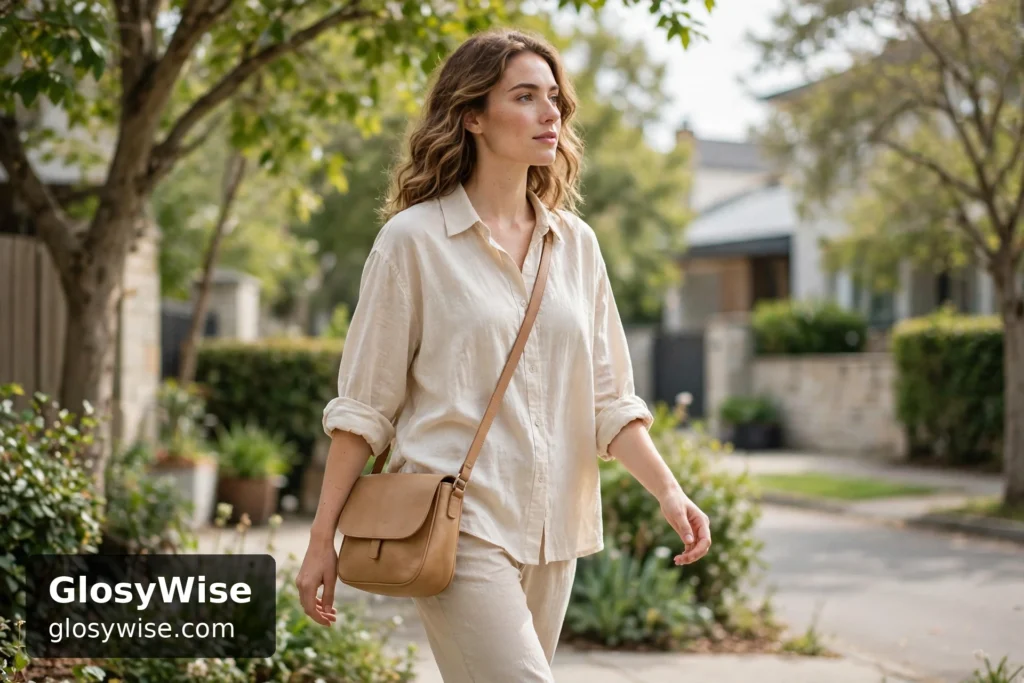
Your first handbag should be a neutral colour.
Black, tan or navy goes with almost every outfit — jeans and a t-shirt, a work outfit, a dress, a coat in winter. A neutral bag does not clash with a patterned top or a coloured scarf.
A bright colour is tempting. A red bag or a pink bag looks exciting in the shop and in photos. But a bright bag only goes with some of your clothes, so you will reach for it less. Save the bright colour for bag number two. It is the same idea as the Minimalist Capsule Wardrobe, where one bag that goes with everything does more work than five bags that only match one outfit each.
Material: Leather vs Nylon vs Canvas
Three materials cover almost every everyday bag.
Leather is the classic choice. It looks good, lasts for years if you look after it, and gets softer with use. It is heavier and costs more. Keep it out of heavy rain and wipe it clean with a dry cloth.
Nylon is light and practical. A nylon bag weighs very little empty and usually survives rain without a mark. It looks more casual than leather. Wipe it clean with a damp cloth.
Canvas is sturdy and relaxed. A canvas tote is strong, easy to carry, and washable in many cases. It suits jeans, trainers and everyday clothes. It can stain, so keep it away from pens and food.
If your bag gets wet often, nylon or canvas makes sense. If you want one smart bag for work and everyday, leather is worth the extra cost.
Straps and Weight: Try It On With Your Things Inside
A bag that looks perfect on a shelf can feel wrong on your shoulder.
Always try a bag on with your things inside it. Put your wallet, phone and keys in, close it, and carry it the way you will carry it. Walk around the shop. Does it sit where you want it? Does the strap stay on your shoulder?
A bag that is heavy empty will be heavy full, so pick it up before you fill it. If it already feels heavy with nothing in it, put it down.
Check the strap length. A crossbody strap should sit at your hip, not at your waist or your knee. A shoulder strap should sit comfortably without digging in. If the strap is adjustable, try two or three lengths.
Budget: One Good Bag Beats Three Cheap Ones
A first handbag does not need to be expensive, but it does need to be well made. One good everyday bag beats three cheap ones — the cheap ones fall apart, look tired after a month, and end up at the back of the wardrobe, while the good one gets used every day. It is the same idea as the Affordable Outfit Ideas for College Students guide: one good piece that works with everything beats several pieces that do not.
Before you pay, check four things. First, the stitching: straight, even and tight, with no loose threads. Second, the zip: it should open and close smoothly, without catching. Third, the lining: neat, fixed in place and free of tears. Fourth, the strap attachments: the rings and stitching where the strap meets the bag should feel strong, because that is where a bag breaks first.
If any check fails, do not buy the bag. A bag with a weak zip or a loose strap is a bag you will replace soon. A good first bag does not need a designer name on it.
5 Mistakes to Avoid
1. Buying for one outfit. A bag that only matches one dress or one pair of shoes is not a first bag.
2. Too small for daily carry. If your wallet does not fit, the bag does not work.
3. Too heavy empty. A bag that is heavy before you put anything in it will only get worse.
4. A trendy colour first. A bright or trendy colour dates quickly and matches less of your wardrobe.
5. Ignoring strap length. A strap that sits in the wrong place will annoy you every day.
For more on styles, materials and colours, Swiftpatra’s guide to choosing a handbag that suits your lifestyle is a useful read: https://www.swiftpatra.com/guide/how-to-choose-a-handbag
FAQs
A medium crossbody or a small tote in a neutral colour — black, tan or navy. A crossbody is the best all-rounder for daily life. A tote is better if you carry a laptop or books every day.
A neutral colour: black, tan or navy. These go with almost everything you own, in every season. Save bright colours for your second bag.
It depends on what you carry. A crossbody is better for errands, commuting and hands-free days. A tote is better if you carry a lot, like a laptop, books or a water bottle.
Big enough for your daily carry plus a little room — no bigger. It should fit your wallet, phone, keys and one or two extras without forcing the zip closed, and it should be light enough to carry with one hand when full.
Spend what your budget allows on one well-made bag, rather than spreading the same money across three cheap ones. Check the stitching, zip, lining and strap attachments before you pay.
Leave a Reply