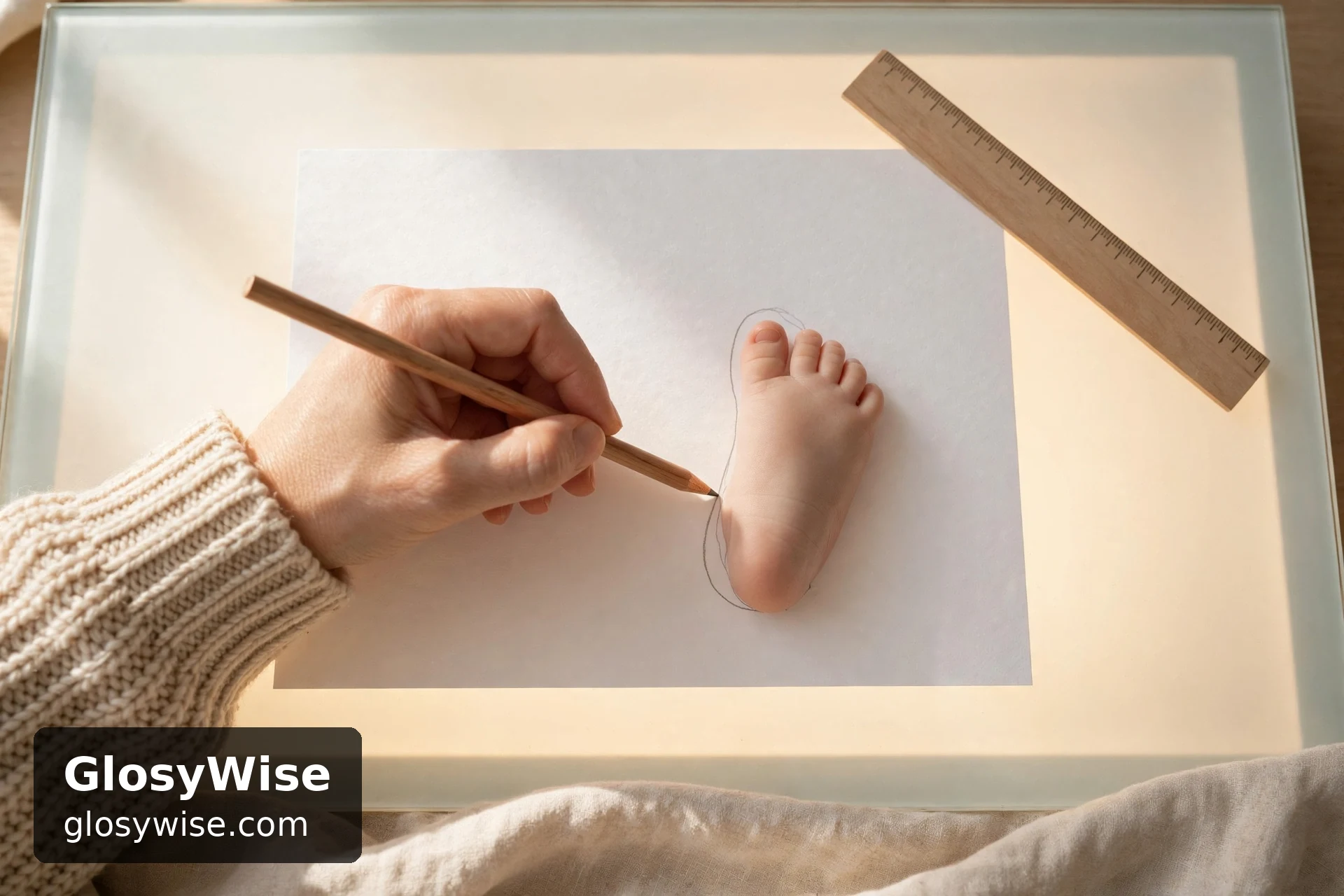
You can measure your baby’s feet at home in about five minutes, with no shop visit and no special tool. Trace each foot on a piece of paper, measure the tracing in centimetres from heel to toe, add growing room, and match the number to a size chart. Measure both feet and use the longer one. That is the whole method — and it beats guessing from your baby’s age, because babies’ feet grow at very different speeds.
Getting the size right matters. Shoes that are too tight can squeeze growing feet and rub blisters, while shoes that are too loose can trip a new walker.
What you need
You probably already have everything at home:
- A sheet of paper — plain A4 or letter paper is fine. For a bigger toddler foot, tape two sheets together.
- A pencil — easier to hold upright against the foot than a pen.
- A ruler marked in centimetres — a tape measure works too.
- The socks your baby will wear with the shoes — always measure with the socks on, because socks add a little length and thickness.
Do it when your baby is calm and fed, not tired or hungry. A quick, happy session gives a much better tracing than a long, fussy one.
The tracing, step by step
1. Put the paper on a hard floor
Lay the paper flat on a hard floor — not on a bed or a rug, which can sink under the foot. Tape the corners down if the paper slides.
2. Stand your baby on the paper, if possible
Standing is best, because weight on the foot spreads it out and makes it a little longer — exactly how the foot will be inside the shoe. Hold their hands for balance. If your baby cannot stand yet, sit them on your lap with the foot flat on the paper and press gently on their knee.
3. Put the heel against the paper’s edge
Line the heel up with one edge of the paper, or against a wall, for a clean starting point.
4. Trace around the foot
Hold the pencil straight up and down and trace slowly around the whole foot, keeping the pencil close to the skin. If your baby wiggles, pause and carry on where you stopped; a small wobble does not matter, because you will measure the longest point, not the outline.
5. Do both feet
Always trace both feet. Almost every baby has one foot slightly longer than the other, and the longer foot decides the shoe size. Mark each tracing “L” and “R”.
Once you have the tracings, check your measurement in the tool — type in the longer foot’s length and it will show you the matching size.
Measure it
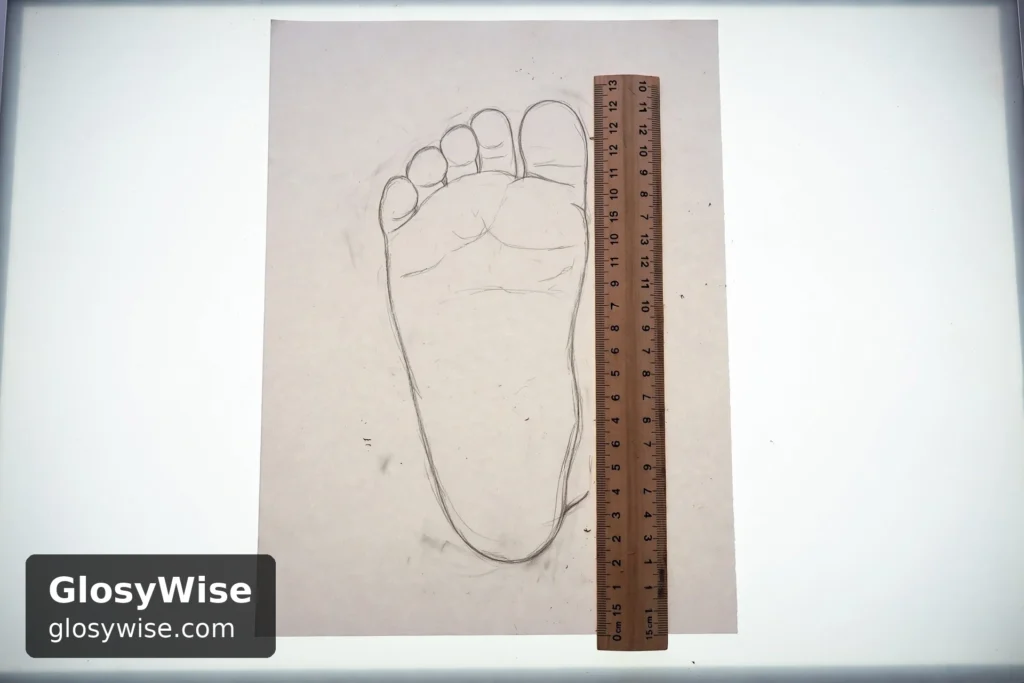
Measure each tracing at its longest point, from the back of the heel to the tip of the longest toe. For most babies the longest toe is the big toe, but sometimes it is the second toe — measure to whichever sticks out furthest.
Write both numbers down, in centimetres, then add growing room: about 10–12 mm (roughly 0.4–0.5 in). This leaves room for the foot to grow and for toes to move freely when your baby walks. Without it, a shoe that fits today will be too small in a few weeks.
For example, a longer foot of 11.4 cm plus about 1 cm of growing room gives 12.4 cm — look for the size whose foot-length range includes 12.4 cm. Keep the tracings, or take a photo of them, so you can check the fit later.
The size chart
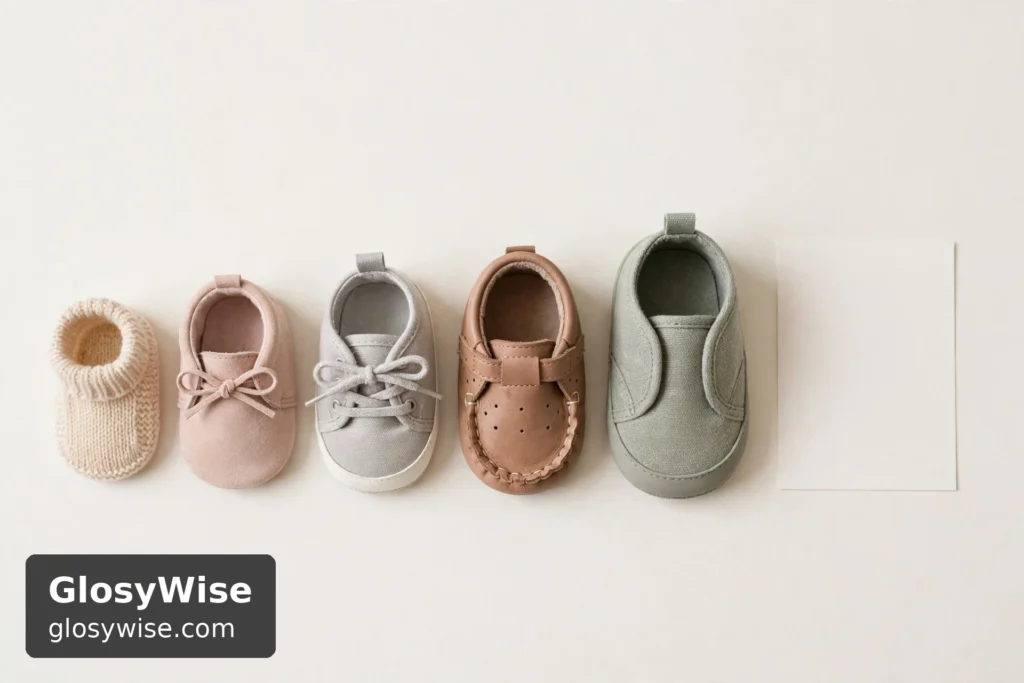
Match your baby’s foot length — before adding growing room — to the chart below. These are approximate standard conversions between US, UK and EU baby sizes. Always check the brand’s own chart too, because sizes can vary slightly between brands.
| Foot length (cm) | US size | UK size | EU size |
|---|---|---|---|
| 9.5 | 2 | 1 | 17 |
| 10.2 | 3 | 2 | 18 |
| 10.8 | 4 | 3 | 19 |
| 11.4 | 5 | 4 | 20 |
| 12.1 | 6 | 5 | 21 |
| 12.7 | 7 | 6 | 22 |
| 13.3 | 8 | 7 | 23 |
If your baby’s measurement falls between two rows, go up to the larger size. Age ranges on shop charts are a rough guide only — length decides. Two babies the same age can easily be two sizes apart. Trust your centimetre number, not the age label. If you shop from a store that uses a different system, use our Shoe Size Converter to switch between US, UK and EU sizes in seconds.
Remeasure often
Baby feet grow fast — in the first year, a baby’s foot can grow by about a size every two to three months. As a rule, remeasure every 4–8 weeks: every two months for babies under two, and every two to three months for toddlers.
Also remeasure if your baby pulls shoes off, trips more than usual, or gets red marks on their feet. A quick check between full measurements: take the shoe’s insole out, if it comes out, and stand your baby on it. If their toes hang over the edge, or there is no thumb-width of space past the longest toe, it is time for the next size.
First walking shoes: what to look for
When your baby starts walking, the right shoe helps rather than hinders:
- Soft and flexible. The shoe should bend easily where the toes bend. If you cannot bend it with one hand, it is too stiff for a new walker.
- Light. Heavy shoes tire little legs quickly.
- Room to wiggle toes. The front should be wide and rounded, not narrow or pointed, so toes can spread out.
- A flat sole with a little grip. A thin, flat sole with a non-slip tread helps your baby feel the ground and stay steady.
- Easy to put on. Velcro straps or a wide opening save a daily struggle.
Before your baby is walking, shoes are mostly for warmth and looks, so soft booties or socks are fine.
5 mistakes to avoid
- Measuring only one foot. One foot is almost always longer. Measure both and buy for the longer one.
- Measuring while the baby sits with the foot dangling. A dangling foot is shorter than a foot with weight on it. Measure standing if you can, or with the foot flat and pressed down.
- Forgetting the socks. Socks add length and thickness. Measure bare feet and the shoes will feel tight once socks go on.
- No growing room. Buying the exact foot length means the shoe is too small within weeks. Always add about 10–12 mm.
- Trusting age instead of length. Age charts are averages. Two 12-month-olds can be two sizes apart. Your centimetre measurement is what counts.
For more detail on tracing, growing room and the size chart, Urban Style Footwear’s guide to measuring baby feet at home is a useful read: https://urbanstylefootwear.com/how-to-measure-baby-feet/
FAQs
Trace each foot on paper with a pencil while your baby stands, measure the tracing from heel to longest toe in centimetres, add about 10–12 mm of growing room, and match the number to a size chart.
About 10–12 mm (roughly 0.4–0.5 in). This leaves room for growth and for toes to move when walking. Add much more and the shoe will be too loose, so your baby may trip.
Every 4–8 weeks for babies, and every two to three months for toddlers. Baby feet grow quickly — often a size every two to three months in the first year.
Yes. Always measure with the socks your baby will wear with the shoes. Socks add a little length and thickness, and measuring with them on means the shoes will fit the way they will actually be worn.
That is normal — almost everyone has one foot slightly bigger than the other. Buy shoes to fit the longer foot. If the difference is very large, or one shoe always slips off, ask a children’s shoe shop to check the fit.
Leave a Reply